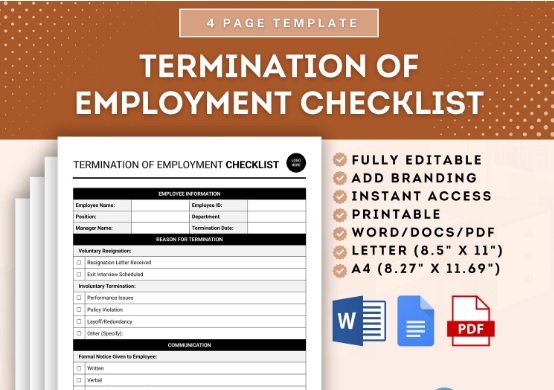
The final 48 hours of an employment exit are not the time to discover that nobody owns the process. Payroll may be waiting for leave figures, information technology may not know the finish time, and the manager may assume human resources has prepared the letter. A clear sequence protects the employee, the business and the people who remain.
Forty-eight hours before the exit, confirm the legal and factual basis
Is the employee resigning, being dismissed, finishing a fixed term or leaving because a role is redundant? The answer affects documents, notice, final pay and communication. A termination checklist for employers should prompt a review of the contract, applicable award or agreement, workplace policies and current legal requirements.
Next, confirm the effective date and time
This matters for system access, final work, property return and pay calculations. The employee should receive any required written notice or acknowledgement. The wording needs to match the real situation and avoid claims that have not been established.
Payroll should receive a verified instruction, not a rough estimate. It may need ordinary wages, approved overtime, allowances, accrued leave, payment in lieu of notice or other amounts that apply. Final pay timing and content can depend on the relevant instrument and circumstances. The payroll team should check current Fair Work guidance and escalate any uncertainty before payment is released.
At the same point, prepare an access plan
List email, shared drives, payroll portals, customer systems, building access, devices and remote connections. Decide which access ends immediately, which remains until the finish time and whether files need to be transferred. Security action should be proportionate to risk and coordinated so the employee is not locked out before completing agreed tasks.
Twenty-four hours before departure, the manager should plan the conversation and handover
The employee may need to explain active work, key contacts, deadlines and file locations. A handover should collect operational facts, not pressure the person to remain available after employment ends. Responsibilities for unfinished work must pass to named employees.
Property return can be handled with a simple list: laptop, phone, keys, cards, tools, uniforms, vehicle, documents and any specialist equipment. The business should record what is returned and agree how remaining items will be collected. Deductions from pay should never be assumed simply because property is missing; the legal basis must be checked.
Benefits and practical arrangements may also need closure. The team should check salary sacrifice items, vehicles, expenses, training repayments, insurance-linked benefits and any employee assistance access. Each item needs its own rule or agreement, so the business should confirm the position rather than use a standard assumption.
Communication to colleagues and clients should be brief, accurate and respectful. It can state that the person is leaving, identify a new contact and explain any immediate work changes. Private reasons, performance claims or health information should not be shared without a proper basis.
On the final day, hold the meeting in a suitable private place
Explain the next steps, provide documents, confirm pay information and allow reasonable questions. Where the employment is being ended by the employer, the process should follow the decision already made and should not turn into an improvised debate.
After the employee leaves, complete the access changes, redirect essential messages and store records securely
Check that personal belongings have been returned and company information remains protected. The manager should also speak with the team about workload and support without encouraging gossip.
A termination checklist for employers is most useful when it names owners and deadlines. “Notify payroll” is weaker than “HR sends the approved calculation request to payroll by noon.” Clear ownership prevents tasks disappearing between departments.
The final review should happen after the exit. Confirm that payment, records, access and communications were completed, and note any failure in the process. Used properly, a termination checklist for employers turns a sensitive final 48 hours into a controlled, lawful and humane close to employment.