Introduction
Alzheimer’s disease is a progressive neurodegenerative condition characterized by changes in brain structure, neuronal function, and protein regulation. Among the biological processes investigated in Alzheimer’s research, abnormal tau phosphorylation and aggregation have received considerable attention. Phosphorylated tau at threonine 181, commonly called p-tau 181, is one of the biomarkers researchers study to better understand these processes and their relationship with disease development.
Advances in analytical methods have expanded opportunities for p-tau 181 research, particularly in studies examining blood-based biomarkers, assay performance, and relationships between tau and amyloid pathology. Researchers are investigating how p-tau 181 measurements vary across sample types, how reliably different platforms quantify the biomarker, and how its concentration relates to other indicators of neurological change. These directions are helping refine the scientific understanding of tau-related biology.
Understanding p-tau 181 and Its Biological Significance
Tau is a protein primarily associated with microtubules, which help maintain neuronal structure and support intracellular transport. In healthy neurons, tau participates in regulating microtubule stability. Its activity is influenced by several biochemical processes, including phosphorylation.
Phosphorylation involves the addition of phosphate groups to specific amino acid residues in a protein. Tau can undergo phosphorylation at multiple sites, and changes in its phosphorylation patterns have been associated with Alzheimer’s disease.
p-tau 181 refers specifically to tau phosphorylated at threonine 181. Researchers investigate this form because changes in its concentration have been associated with Alzheimer’s-related biological processes.
It is important to distinguish p-tau 181 from other tau measurements:
- Total tau (t-tau): Measures tau protein without focusing on one specific phosphorylation site.
- p-tau 181: Measures tau phosphorylated at threonine 181.
- p-tau 217: Measures phosphorylation at threonine 217 and is another extensively investigated Alzheimer’s-related biomarker.
- p-tau 231: Measures phosphorylation at threonine 231 and provides a different perspective on tau-related changes.
These biomarkers are not interchangeable. Each reflects a different molecular feature, and their performance depends on the assay, sample type, and research context.
Current Research Direction 1: Blood-Based p-tau 181 Measurement
One of the most active areas of Alzheimer’s biomarker investigation involves measuring tau-related proteins in blood.
Historically, cerebrospinal fluid (CSF) has been an important sample source for studying Alzheimer’s-related biomarkers. However, obtaining CSF requires lumbar puncture, which is more invasive than routine blood collection. Plasma and serum are therefore being investigated as more accessible alternatives for biomarker research.
Why Blood-Based Testing Matters
Blood-based p-tau 181 measurement may offer several research advantages:
- Easier collection compared with CSF.
- Potential suitability for larger research cohorts.
- Opportunities for repeated sampling.
- Support for longitudinal biomarker studies.
- Potential use in research screening strategies.
However, blood contains many proteins and other substances that can affect analytical performance. p-tau 181 concentrations may also be relatively low in some samples. Researchers therefore need sensitive and selective assays that are validated for the specific blood matrix.
Remaining Research Questions
Current investigations include evaluating how plasma p-tau 181 relates to CSF measurements, amyloid imaging, tau imaging, and clinical characteristics. Researchers are also examining whether performance differs across populations and disease stages.
Blood-based p-tau 181 should be interpreted according to the validation evidence for the specific assay. Results from one platform should not automatically be treated as equivalent to those from another.
Current Research Direction 2: Exploring the Relationship Between Amyloid and Tau
Alzheimer’s disease involves several interconnected biological processes. Amyloid-beta accumulation and tau-related changes are two major areas of investigation.
Amyloid-beta peptides can aggregate and form plaques in the brain. Tau can undergo abnormal phosphorylation and aggregation, contributing to the formation of neurofibrillary tangles. Researchers are interested in understanding how these processes interact and how their timing relates to disease development.
The Role of p-tau 181
p-tau 181 is investigated alongside amyloid-related biomarkers to explore relationships between amyloid pathology and tau changes.
For example, studies may compare p-tau 181 concentrations with:
- Amyloid-beta 42.
- Amyloid-beta 40.
- The Aβ42/Aβ40 ratio.
- Amyloid PET imaging results.
- Other phosphorylated tau measurements.
These comparisons can help researchers examine whether changes in amyloid status are associated with changes in tau-related biomarkers.
Why Combined Biomarker Analysis Is Important
Amyloid and tau measurements provide different information. Amyloid-related biomarkers reflect amyloid processing and deposition, while p-tau 181 provides insight into a particular form of phosphorylated tau.
Studying both may help researchers characterize biological patterns more comprehensively than relying on a single biomarker. However, relationships between these markers can vary, and combined measurements should be interpreted within the context of the study design.
Current Research Direction 3: Comparing Different p-tau Biomarkers
Although p-tau 181 remains an important research target, scientists are also investigating other phosphorylated tau forms.
p-tau 217 and p-tau 231 have attracted attention because they may provide additional information about Alzheimer’s-related tau changes. Comparative studies can help determine whether particular phosphorylation sites offer different advantages for specific research questions.
p-tau 181
p-tau 181 has been studied in CSF and blood-based research. It is frequently investigated in relation to amyloid pathology and other Alzheimer’s biomarkers.
p-tau 217
p-tau 217 has become a prominent focus of blood-based biomarker research. Studies have explored its relationship with amyloid pathology and its potential analytical performance in different sample types.
p-tau 231
p-tau 231 is another candidate biomarker used to investigate early tau-related changes. Researchers are studying its relationship with amyloid pathology and other molecular indicators.
Comparing Biomarker Performance
A meaningful comparison should consider:
- Analytical sensitivity and specificity.
- Sample type and collection procedures.
- Assay calibration and measuring range.
- Relationship with established biomarkers.
- Reproducibility across research populations.
- Performance in longitudinal studies.
No single phosphorylation site should be assumed to provide the best information in every setting. The most suitable marker depends on the research objective and available validation evidence.
Current Research Direction 4: Improving Immunoassay Performance
Reliable p-tau 181 measurement depends heavily on analytical method quality. Immunoassays are widely used in biomarker research because antibodies can recognize specific molecular targets.
However, measuring a phosphorylated protein presents particular challenges. Antibodies must recognize the intended phosphorylation site while minimizing responses to other tau forms.
Antibody Specificity
The capture and detection antibodies used in an immunoassay should be evaluated for their ability to recognize p-tau 181 selectively.
Researchers should investigate potential cross-reactivity with non-phosphorylated tau and tau phosphorylated at other sites. Antibody affinity, reagent consistency, and compatibility between antibody pairs can also influence performance.
Analytical Sensitivity
p-tau 181 may occur at low concentrations, especially in some blood-based samples. Assays therefore require appropriate sensitivity for the intended sample type.
Important analytical parameters include:
- Limit of blank.
- Limit of detection.
- Limit of quantification.
- Precision at low concentrations.
- Signal-to-background performance.
These characteristics should be established through validation rather than inferred from general instrument specifications.
Reproducibility
Reproducible measurements are essential when comparing results across study participants, experimental batches, or research sites.
Laboratories can evaluate reproducibility by testing samples repeatedly, monitoring quality-control materials, and assessing variation between runs, operators, and reagent lots.
Current Research Direction 5: Chemiluminescence Immunoassay Technology
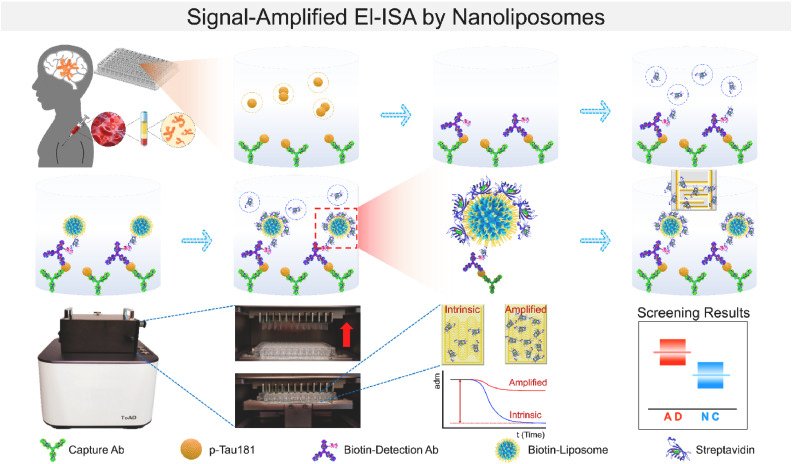
Chemiluminescence immunoassay (CLIA) is an analytical approach that combines antibody-based recognition with light-producing chemical reactions.
In a typical CLIA workflow, antibodies bind the target analyte, and a detection system generates light through a chemical reaction. An analyzer measures the emitted signal and relates it to analyte concentration through calibration.
Potential Advantages for Biomarker Research
CLIA platforms may support p-tau 181 measurement through:
- Sensitive signal detection.
- Automated sample and reagent handling.
- Standardized incubation and reaction procedures.
- Consistent signal measurement.
- Support for routine laboratory workflows.
Automation can reduce some sources of manual variability, but it does not remove the need for assay-specific validation.
Considerations When Selecting a CLIA Platform
Laboratories evaluating an analyzer for p-tau 181 research should consider its measurement capabilities, throughput, precision, maintenance requirements, and compatibility with the intended assay reagents.
The complete analytical system must be evaluated. An analyzer’s general ability to perform chemiluminescence measurements does not automatically establish that a particular p-tau 181 assay is compatible or validated for use on that instrument.
Current Research Direction 6: Longitudinal Studies and Biomarker Changes
Longitudinal research follows participants over time to investigate how biological measurements change. This approach is particularly valuable in Alzheimer’s research because molecular changes may develop over extended periods.
Repeated p-tau 181 measurements can help researchers investigate:
- Changes in biomarker concentrations over time.
- Relationships between biomarker patterns and cognitive performance.
- Associations with amyloid-related measurements.
- Differences between research populations.
- Potential changes associated with disease progression.
Longitudinal studies require consistent analytical methods. Changes in assay platforms, sample handling, or calibration procedures can introduce variation that may be mistaken for biological change.
Researchers should therefore use standardized collection protocols, validated measurement procedures, and carefully documented quality-control practices.
Current Research Direction 7: Integrating p-tau 181 with Other Biomarkers
Alzheimer’s disease cannot be fully characterized through one molecular measurement. Researchers increasingly investigate combinations of biomarkers to examine different aspects of the disease process.
The AT(N) framework is one example of a research approach that organizes biomarkers into three broad categories:
- A — Amyloid: Indicators of amyloid-beta pathology.
- T — Tau: Indicators of pathological tau changes.
- N — Neurodegeneration or neuronal injury: Indicators of neuronal damage or loss.
p-tau 181 is relevant to the tau category, while amyloid-beta measurements and imaging can provide information about amyloid pathology. Other biomarkers, imaging findings, and cognitive assessments may contribute additional context.
Combining different types of evidence can help researchers develop more detailed biological profiles. The framework is primarily a research classification approach and should not be treated as a standalone clinical diagnosis.
Challenges in Current p-tau 181 Research
Despite advances in biomarker science, several issues continue to influence the reliability and interpretation of p-tau 181 results.
| Challenge | Research impact | Important consideration |
|---|---|---|
| Low concentrations in blood | Difficulties with quantification | Validate sensitivity in the intended matrix |
| Antibody cross-reactivity | Potentially misleading measurements | Assess target specificity |
| Sample handling differences | Pre-analytical variability | Standardize collection and storage |
| Platform differences | Limited result comparability | Conduct method-comparison studies |
| Calibration variation | Inconsistent quantitative results | Monitor calibrators and quality controls |
| Population differences | Variable biomarker patterns | Evaluate performance across cohorts |
| Complex disease biology | Difficult interpretation | Combine complementary evidence |
Addressing these challenges is necessary for producing robust findings and improving the comparability of research results.
Future Opportunities in p-tau 181 Investigation
Several developments may influence the next phase of p-tau 181 research.
More Accessible Blood-Based Biomarker Methods
Continued work on plasma assays may support broader biomarker studies and repeated measurements. Researchers will need to establish reliable analytical thresholds and evaluate performance across diverse populations.
Improved Assay Standardization
Greater consistency in calibrators, antibody characterization, quality-control procedures, and reporting practices could improve comparisons between laboratories.
Multiplex Testing
Multiplex platforms aim to measure several biomarkers in a single sample. Combining p-tau 181 with amyloid-related and other neurological biomarkers may help researchers investigate relationships between different biological processes.
Integration with Imaging and Clinical Data
Combining molecular measurements with PET imaging, cognitive assessments, and longitudinal observations may provide a more complete understanding of Alzheimer’s-related changes.
More Detailed Molecular Characterization
Advances in analytical methods may help researchers investigate different tau forms and phosphorylation patterns. This could provide additional insight into the molecular diversity of tau-related pathology.
Conclusion
p-tau 181 remains an important biomarker in Alzheimer’s disease research because it provides information about a specific form of phosphorylated tau. Current research is expanding beyond traditional cerebrospinal fluid measurements to include blood-based testing, comparisons with other phosphorylated tau forms, improved immunoassays, and integrated biomarker analysis.
These developments are strengthening the tools available to investigate amyloid and tau biology. However, reliable conclusions depend on appropriate sample handling, analytical validation, assay specificity, and consistent measurement procedures.
As research advances, p-tau 181 will continue to contribute to investigations of Alzheimer’s-related molecular changes. Its greatest value comes from interpreting it alongside complementary biomarkers, imaging findings, and relevant research evidence rather than treating a single measurement as a complete representation of disease.