Corporate events provide opportunities for employees to connect, celebrate achievements, and strengthen professional relationships outside their usual work environment. However, traditional event formats that rely mainly on speeches, presentations, and formal networking can sometimes make it difficult for participants to interact naturally. Adding recreational activities can create a more relaxed atmosphere and encourage greater involvement.
Inflatable games offer an interactive way to bring employees together through friendly competition, physical challenges, and team-based activities. Whether organized during company picnics, annual celebrations, team-building sessions, or employee appreciation days, these attractions can help make corporate gatherings more memorable. When selected carefully, Inflatable Games can support employee engagement while giving participants opportunities to communicate, collaborate, and enjoy shared experiences.
Why Employee Engagement Matters at Corporate Events
Employee engagement refers to the level of interest, involvement, and connection people feel toward their work and organization. Corporate events can support these relationships by creating opportunities for employees to interact beyond their daily responsibilities.
A well-planned event allows colleagues from different departments to meet, share experiences, and develop a stronger sense of belonging. Interactive activities can make these opportunities more accessible by giving participants a common goal or an enjoyable experience to discuss.
Rather than expecting employees to network through formal conversations alone, event organizers can introduce activities that encourage natural interaction. This approach can be particularly useful when employees work remotely, belong to different departments, or rarely communicate outside scheduled meetings.
How Inflatable Games Improve Corporate Event Engagement
1. Encourage Teamwork and Collaboration
Team-based inflatable activities can give employees a shared objective that requires communication and cooperation. Obstacle course races, relay challenges, and group competitions encourage participants to coordinate their actions and support their teammates.
These experiences create an informal setting where employees can practice working together without the pressure associated with workplace deadlines. Participants may also discover different strengths among their colleagues.
For the best results, organizers should create balanced teams and choose activities that reward cooperation rather than relying entirely on speed or physical strength.
2. Break Down Workplace Barriers
Corporate hierarchies and departmental responsibilities can sometimes limit informal communication. Employees may interact regularly with their immediate colleagues but have fewer opportunities to connect with managers or staff from other teams.
Recreational activities provide a shared experience in which participants can interact in a less formal environment. When employees from different roles work toward the same objective, conversations can develop more naturally.
Organizers can encourage this interaction by mixing departments into teams and avoiding arrangements that separate participants according to seniority.
3. Create a More Energetic Atmosphere
Long meetings and formal presentations can make some corporate events feel predictable. Interactive attractions introduce movement, variety, and opportunities for active participation.
Sports-themed inflatable challenges, target games, and obstacle courses can create focal points that draw attention and encourage employees to join in. These activities may be especially useful during outdoor company gatherings, employee appreciation events, and annual celebrations.
The key is to balance active entertainment with quieter options, refreshments, and opportunities for conversation so that participants can choose how they want to engage.
4. Promote Friendly Competition
Friendly competition can add excitement to a corporate gathering when activities are designed around clear and fair rules. Employees may compete in teams to complete an obstacle course, achieve a target score, or finish a relay challenge.
Leaderboards, timed rounds, and small recognition awards can give participants an additional reason to get involved. However, the emphasis should remain on shared enjoyment rather than creating unnecessary pressure.
Inclusive rules and varied activities help ensure that employees with different physical abilities and confidence levels can participate meaningfully.
5. Support Employee Well-Being
Workplace well-being includes opportunities for social connection, recreation, and breaks from routine responsibilities. Corporate events that incorporate enjoyable physical activities can provide employees with a change of pace.
Some inflatable games encourage jumping, walking, balancing, or other movements that get participants away from their desks. While these activities are not a substitute for regular exercise or a comprehensive employee wellness program, they can add an active element to a company event.
Providing less physically demanding alternatives also allows employees to participate according to their preferences and abilities.
6. Make Corporate Events More Memorable
Employees are more likely to remember an event when they have actively participated in a meaningful experience rather than simply observed a program. Shared challenges, humorous moments, and team achievements can become positive memories that colleagues discuss afterward.
Inflatable games can help create these experiences by giving participants something tangible to do together. Event organizers can also use themed competitions or department-based challenges to connect recreational activities with the purpose of the gathering.
The most memorable events typically combine entertainment with thoughtful planning, comfortable facilities, and opportunities for genuine interaction.
Best Types of Inflatable Games for Corporate Events
Choosing appropriate activities depends on the event’s objectives, available space, expected attendance, and participant preferences. Different formats can support different engagement goals.
Inflatable Obstacle Courses
Obstacle courses are suitable for corporate outdoor events where participants want a more active challenge. They may include tunnels, climbing sections, barriers, and other features that require participants to navigate a defined route.
Organizers can use timed races or team relays to encourage cooperation and create a friendly competitive atmosphere. Separate rounds can help manage participation when attendance is high.
The selected course should be appropriate for the participants and the venue, with sufficient room for installation, entry and exit, supervision, and safe movement around the equipment.
Inflatable Sports Games
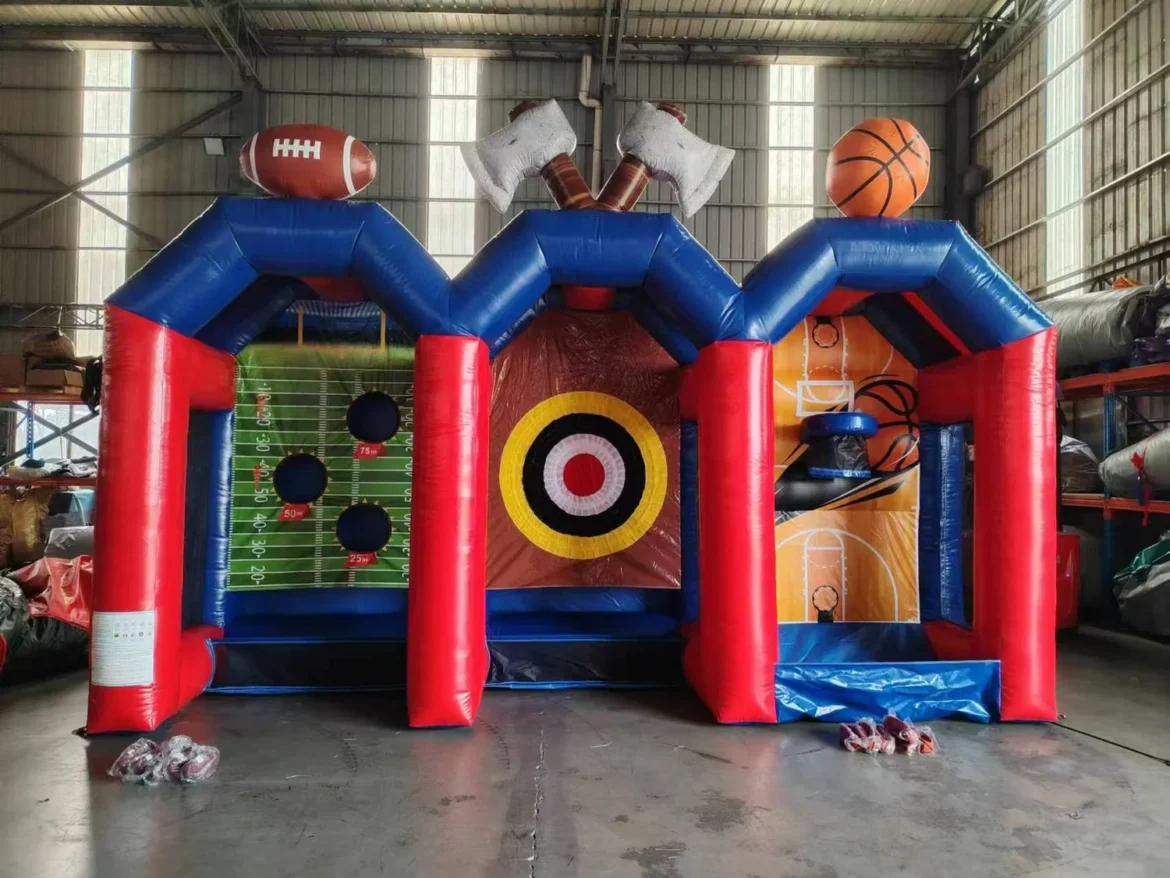
Inflatable sports activities may include basketball challenges, soccer target games, football throwing contests, and other skill-based competitions.
These games can be easier to organize than large obstacle courses because many use simple objectives that participants understand quickly. They also allow event planners to create activity stations where employees can rotate between different challenges.
Sports-themed attractions are useful when organizers want to encourage participation without requiring every employee to complete the same physical task.
Inflatable Interactive Games
Interactive games focus on accuracy, reaction time, problem-solving, or completing specific tasks. Examples include target challenges and competitive games in which participants earn points by meeting defined objectives.
These activities can work well at exhibitions, indoor corporate gatherings, product launches, and company celebrations, provided the equipment is suitable for the venue.
Because some interactive games require less physical exertion, they can offer a useful alternative for employees who prefer skill-based participation.
Inflatable Team Challenges
Team challenges are designed around cooperation rather than individual performance. Depending on the equipment, participants may complete relays, coordinate movements, or work together to achieve a common goal.
These activities are particularly relevant to team-building events because they encourage communication and shared decision-making. Organizers can follow each challenge with a short discussion about collaboration, problem-solving, or the experience of working together.
Such discussions should remain constructive and optional where appropriate, rather than turning every recreational activity into a formal workplace assessment.
How to Integrate Inflatable Games Into a Corporate Event Schedule
Successful event planning requires more than arranging equipment at a venue. Activities should fit naturally into the schedule and support the overall purpose of the gathering.
Start With Clear Event Objectives
Determine what the company wants to achieve. An employee appreciation day may prioritize relaxation and enjoyment, while a team-building event may focus more heavily on communication and collaboration.
Once the objectives are clear, organizers can select activities that match the desired experience. A mixture of team competitions, open-play stations, and quieter social areas can accommodate different interests.
Plan Activities Around Attendance
Estimate how many employees will attend and how many people each attraction can safely accommodate. Large groups may need scheduled rounds, sign-up slots, or several activity stations to reduce waiting times.
For example, a company event with employees from multiple departments could rotate teams between sports challenges, interactive games, and refreshment areas. This format encourages movement throughout the venue and creates more opportunities for people to meet.
All participation arrangements must respect the equipment’s stated capacity and operating requirements.
Create Balanced Teams
Mixing employees from different departments can encourage new connections and reduce the tendency for colleagues to remain within familiar groups. Teams can also be organized around shared interests or randomly assigned to introduce an element of variety.
Avoid making participation dependent on athletic ability. Where appropriate, combine physically active challenges with games based on accuracy, strategy, or communication.
Include Recognition and Rewards
Small prizes, certificates, or team recognition can add interest to friendly competitions. Rewards do not need to be expensive to make an activity enjoyable.
Organizers can recognize collaboration, creativity, fair play, and team spirit in addition to winning. This helps maintain an inclusive atmosphere and prevents the event from becoming overly focused on individual performance.
Allow Time for Social Interaction
A tightly packed schedule can reduce the opportunities employees have to talk and relax. Build in breaks between activities and provide comfortable areas where participants can socialize.
Refreshment stations, shaded seating, and informal networking spaces can complement the attractions and make the event more comfortable for employees who prefer not to participate in every game.
Indoor vs. Outdoor Corporate Events
The venue has a major influence on which inflatable activities are practical.
Indoor Corporate Events
Indoor venues can be suitable for smaller inflatable attractions, interactive games, and selected sports challenges. Before booking equipment, organizers should confirm ceiling height, floor capacity, access routes, power supply, and available installation space.
The inflatable structure must fit within the venue without obstructing exits, walkways, fire equipment, or other essential facilities. Noise levels and neighboring event activities may also need consideration.
Outdoor Corporate Events
Outdoor venues can accommodate larger attractions, including some obstacle courses and sports-themed inflatables. Parks, company grounds, and dedicated event spaces may provide more room for group competitions.
However, outdoor installations require careful attention to ground conditions, anchoring, weather, drainage, and electrical safety. Operators must follow manufacturer-defined weather limits and suspend activities when conditions become unsafe.
The choice between indoor and outdoor entertainment should reflect the equipment requirements as well as employee comfort and event logistics.
Safety and Accessibility Considerations
Employee engagement should never come at the expense of safety. Inflatable equipment must be installed and operated according to the manufacturer’s instructions and applicable local requirements.
Before the event, organizers should confirm the equipment’s condition, anchoring method, participant capacity, inspection arrangements, and supervision requirements. They should also clarify who is responsible for installation, operation, emergency procedures, and equipment removal.
Additional precautions include:
- Selecting activities appropriate for the intended participants.
- Providing clear instructions and enforcing capacity limits.
- Maintaining unobstructed entry points, exits, and emergency access routes.
- Monitoring weather and stopping outdoor operations when conditions exceed permitted limits.
- Offering alternative activities for employees who cannot or do not wish to participate in strenuous physical challenges.
- Ensuring suitable accessibility arrangements and reasonable opportunities for everyone to engage.
A well-organized event provides choices rather than pressuring every employee to participate in the same activity.
Budgeting for Inflatable Games at Corporate Events
The cost of adding inflatable attractions varies according to equipment size, complexity, rental duration, delivery distance, staffing, and installation requirements. The overall budget may also include venue preparation, insurance, electricity, cleaning, and event management.
Renting is often practical for companies that organize occasional events because it can reduce long-term storage and maintenance responsibilities. Purchasing may be worth evaluating for organizations that host frequent events and have suitable facilities for equipment storage and operation.
When comparing quotations, organizers should look beyond the initial price. Confirm what the supplier includes, whether trained operators are provided, what happens in poor weather, and who is responsible for setup, inspection, repairs, and removal.
A clear budget helps companies choose attractions that offer meaningful participation without diverting resources from other important aspects of the event.
How to Measure the Success of Inflatable Activities
Corporate event engagement can be evaluated through several practical indicators. Attendance alone may not reveal whether employees found the activities valuable, so organizers should consider both participation and feedback.
Useful measures include:
- Participation rates: The proportion of employees who join at least one activity.
- Activity completion: The number of scheduled sessions completed and any recurring bottlenecks.
- Employee feedback: Comments about enjoyment, accessibility, organization, and the quality of the experience.
- Cross-team interaction: Feedback on whether employees had opportunities to connect with colleagues outside their usual departments.
- Operational performance: Whether the activities stayed within budget and met the planned schedule and safety requirements.
Short post-event surveys can help identify which activities employees enjoyed and what could be improved. Results should be interpreted in context, since an entertaining event does not automatically lead to measurable improvements in long-term employee engagement.
Conclusion
Inflatable games can make corporate events more engaging by encouraging teamwork, breaking down communication barriers, introducing friendly competition, and creating shared experiences. From obstacle courses and sports challenges to interactive activities, different formats can support a range of corporate event objectives.
The most effective approach is to select activities that suit the audience, venue, budget, and event schedule. With careful planning, appropriate supervision, inclusive options, and clear safety procedures, inflatable attractions can complement corporate gatherings and help employees connect in a relaxed and enjoyable environment.