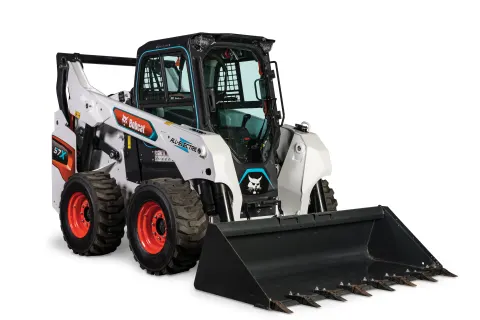
Battery efficiency is one of the most important factors affecting the performance of electric skid steer loaders. Unlike diesel-powered machines, electric models depend on stored electrical energy to power their motors, hydraulic systems, and other operating functions. Battery capacity, energy management, charging methods, and component efficiency all influence how long a machine can work before it needs to recharge.
Manufacturers improve battery performance through careful engineering, suitable component selection, thermal management, and system-level testing. An experienced Electric Skid Steer Loaders Manufacturer considers the relationship between the battery, electric motors, hydraulic system, and machine controls to help deliver reliable performance under real working conditions.
Understanding these design strategies helps construction companies and equipment buyers evaluate electric skid steer loaders more effectively and choose equipment that suits their daily workloads.
1. Selecting the Right Battery Technology
Battery selection establishes the foundation for an electric skid steer loader’s operating performance. Manufacturers must consider energy capacity, power output, weight, charging requirements, expected service life, and operating conditions.
Lithium-ion batteries are commonly used in electric equipment because they can offer high energy density, effective power delivery, and relatively low maintenance requirements. However, performance varies according to battery chemistry, pack design, temperature, and charging practices.
When selecting a battery, manufacturers typically evaluate several factors:
- Energy capacity: Determines how much energy the battery can store.
- Power output: Affects the battery’s ability to support demanding operations.
- Cycle life: Indicates how the battery may perform over repeated charge and discharge cycles under specified conditions.
- Weight and dimensions: Influence machine packaging and weight distribution.
- Thermal characteristics: Affect performance across different temperatures.
- Charging compatibility: Determines which charging equipment and charging rates can be used.
The most suitable battery is not necessarily the one with the largest capacity. Manufacturers must balance runtime, machine weight, purchase cost, charging time, and the power required for the intended application.
2. Optimizing Battery Capacity for Real Workloads
A larger battery can store more energy, but increasing battery capacity also adds weight, takes up space, and may increase equipment cost. Manufacturers therefore need to match battery capacity to the machine’s intended operating cycle.
For example, a loader used for short material-handling tasks inside a warehouse may have different energy requirements from a machine used for continuous loading at a construction site.
Engineers may estimate energy consumption by considering:
- Average motor power during operation.
- Frequency and duration of lifting tasks.
- Hydraulic demand from attachments.
- Travel distance and ground conditions.
- Idle periods and operator work patterns.
- Ambient temperature and charging opportunities.
These estimates help determine whether a battery can support the expected work period without frequent interruptions.
Manufacturers may also evaluate different operating scenarios to understand how energy demand changes under light, moderate, and demanding workloads. Buyers should review runtime estimates alongside the conditions under which they were measured, because advertised operating hours may not represent every job site.
3. Improving Electric Motor Efficiency
Electric motors convert stored electrical energy into mechanical power. Their efficiency affects how much battery energy is used to move the machine and perform work.
Manufacturers can improve motor-system efficiency by selecting suitable motor designs, matching motor characteristics to the intended workload, and coordinating motor operation with electronic controls.
Important considerations include torque delivery, operating speed, thermal performance, and the efficiency of the motor across its working range.
An efficiently designed motor system can help reduce unnecessary energy consumption during common tasks. However, overall battery performance depends on the complete machine rather than the motor alone.
The controller, drivetrain, hydraulic pump, tires or tracks, and attachment loads also influence energy use. A well-integrated system helps the machine deliver the required performance without wasting energy through poorly matched components or inefficient operating strategies.
4. Using Advanced Battery Management Systems
A battery management system (BMS) monitors battery conditions and helps keep operation within specified limits. Depending on its design, it may track cell voltage, current, temperature, state of charge, and other relevant parameters.
The BMS can support battery protection by detecting conditions that require warnings, power limitations, or protective shutdowns. It may also help balance cells in supported battery configurations.
Battery management features can contribute to:
- More accurate battery-status information.
- Detection of abnormal operating conditions.
- Protection against specified electrical limits being exceeded.
- Monitoring of temperature and charging behavior.
- Improved communication between the battery and machine controls.
The exact capabilities depend on the battery system and its software. A BMS does not eliminate every battery risk, but appropriate monitoring and protection can help improve reliability and support safer operation.
Manufacturers should ensure that the battery, charger, motor controller, and machine display communicate correctly. Clear fault codes and diagnostic information can also help technicians identify issues more quickly.
5. Managing Battery Temperature
Temperature has a significant effect on battery performance. Excessive heat can accelerate battery aging, while low temperatures can reduce available power and charging capability.
Manufacturers must therefore design battery enclosures and thermal management arrangements that suit the selected battery chemistry and expected operating environment.
Depending on the battery system, temperature management may involve passive cooling, forced-air cooling, liquid cooling, or other manufacturer-approved approaches. Not every electric skid steer loader uses active liquid cooling.
Effective thermal design considers the battery’s location, surrounding components, ventilation, protective enclosures, and heat generated during operation or charging.
Manufacturers may evaluate battery temperatures under different loads and ambient conditions to identify potential thermal issues.
For equipment buyers, it is important to check the specified operating-temperature range and any restrictions on charging in cold or hot conditions. Following the manufacturer’s charging and storage instructions can help preserve battery performance over time.
6. Reducing Energy Losses in the Hydraulic System
Hydraulic functions can account for a substantial portion of energy consumption in a skid steer loader, particularly when the machine frequently lifts heavy loads or operates power-demanding attachments.
Even when the machine uses an electric motor, energy can be lost through hydraulic restrictions, unsuitable pressure settings, internal leakage, or inefficient component matching.
Manufacturers can improve hydraulic efficiency by selecting suitable pumps and valves, designing appropriate flow paths, and matching hydraulic capacity to the machine’s intended work.
Potential improvements include:
- Reducing unnecessary pressure losses.
- Using appropriately sized hydraulic components.
- Minimizing avoidable leakage.
- Coordinating pump output with operating demand.
- Matching attachment flow requirements to the machine’s specifications.
- Providing suitable maintenance access for hydraulic components.
These measures can help reduce the energy required to perform lifting and attachment tasks.
Hydraulic efficiency must still be balanced with responsiveness, lifting performance, and safety. Buyers should verify the machine’s hydraulic flow and pressure specifications when planning to use specialized attachments.
7. Improving Energy Management Through Software
Electronic control systems can influence how efficiently an electric skid steer loader uses battery energy. Depending on the machine, software may coordinate motor output, travel speed, hydraulic functions, and operating modes.
Some machines provide different performance settings. A lower-power or economy mode may reduce energy consumption during lighter tasks, while a higher-performance mode may be more suitable for demanding operations.
Manufacturers can refine control strategies to help the machine respond appropriately to operator inputs and avoid unnecessary power demand.
Useful energy-management features may include:
- Adjustable travel or performance modes.
- Battery state-of-charge displays.
- Power limitation when specified battery conditions are reached.
- Fault monitoring and diagnostic alerts.
- Coordinated motor and hydraulic control.
- Energy-use information, where supported.
Software updates and calibration may also improve system behavior when performed through approved procedures. However, buyers should confirm which features are actually available on the model under consideration rather than assuming every electric loader includes advanced energy-management functions.
8. Designing for Regenerative Energy Recovery
Regenerative braking can recover some kinetic energy during deceleration by using an electric motor as a generator. The recovered energy can then be returned to the battery when the machine’s powertrain supports this function.
The amount of energy recovered depends on the motor and controller design, battery acceptance limits, machine speed, load, terrain, and operating pattern.
In skid steer loaders, the benefits of regenerative energy recovery may differ from those in road vehicles because operating cycles often involve short movements, frequent turns, and hydraulic work.
Manufacturers may evaluate whether regenerative functions are practical for the machine’s drive system and how they interact with braking and control requirements.
Regeneration should be treated as a supplementary efficiency measure, not a substitute for suitable battery capacity or effective energy management. Buyers should ask whether the machine supports regenerative operation and whether the manufacturer provides performance information for that feature.
9. Reducing Unnecessary Machine Weight
Machine weight influences energy consumption, particularly during travel, acceleration, turning, and operation on uneven ground. At the same time, the structure must remain strong enough to handle the loads for which the machine is designed.
Manufacturers therefore aim to balance structural durability with efficient packaging and appropriate material use.
Design approaches may include optimizing frame geometry, reducing unnecessary material, integrating components more effectively, and selecting suitable lightweight materials where practical.
Weight reduction must not compromise frame strength, stability, rated capacity, or resistance to operating stresses. The objective is to eliminate unnecessary weight while maintaining the machine’s required structural and safety characteristics.
Battery placement also matters. Proper weight distribution helps support machine balance and predictable handling.
For buyers, rated operating capacity, tipping load, machine weight, and intended attachment use should be considered together. A lighter machine is not automatically more efficient or more suitable for every job.
10. Improving Charging Efficiency and Convenience
Charging affects both battery performance and equipment productivity. A machine that cannot be recharged conveniently between shifts may require a larger battery or changes to the work schedule.
Manufacturers can support efficient charging by designing the battery system around compatible charging equipment, providing clear charging specifications, and ensuring that the charging interface is suitable for the intended operating environment.
Important factors include:
- Battery capacity and recommended charging rate.
- Charger compatibility and connector type.
- Available electrical supply.
- Charging time under specified conditions.
- Temperature-related charging restrictions.
- Access to charging facilities during work breaks or shift changes.
Charging time depends on the battery’s condition, charger output, charging curve, temperature, and the starting state of charge. A charger with a higher rated output does not necessarily charge every battery faster if the battery management system limits the accepted current.
Fleet operators should plan charging around actual work cycles and available electrical infrastructure. They should also follow the manufacturer’s instructions instead of relying on unverified charging methods or incompatible equipment.
11. Testing Battery Performance Before Delivery
Battery efficiency should be assessed through appropriate testing rather than estimated from component specifications alone. Manufacturers may perform electrical checks, charging tests, diagnostic verification, and functional tests as part of their quality-control process.
The specific testing program varies by model and manufacturer, but it should verify that the battery and connected systems operate according to their design requirements.
Testing may include:
- Checking battery voltage and monitoring functions.
- Verifying communication between the battery and controller.
- Confirming charger compatibility.
- Inspecting connectors and electrical protection.
- Reviewing battery-related warning indicators.
- Evaluating machine operation under defined test conditions.
Where runtime or energy-consumption claims are provided, buyers should ask about the test conditions. Payload, attachment type, operator behavior, temperature, terrain, and the amount of hydraulic work can all affect results.
Documented testing gives buyers a clearer basis for comparing machines than broad claims about battery efficiency.
12. How Manufacturing Quality Affects Battery Longevity
Battery longevity depends on more than the quality of the battery cells. Mechanical protection, electrical integration, thermal management, charging controls, and maintenance access also affect long-term performance.
Manufacturers can support battery durability by using suitable enclosures, protecting cables and connectors, following appropriate assembly procedures, and integrating the battery with compatible controllers and charging equipment.
Poor installation or unsuitable system configuration may create avoidable problems, even when the battery itself is well manufactured.
Buyers should ask about the battery warranty, its coverage conditions, the availability of replacement components, and the recommended inspection schedule. It is also useful to understand how the battery’s state of health is evaluated and whether diagnostic support is available.
Battery performance will naturally change over time, but appropriate design, operation, and maintenance can help manage degradation. The actual service life depends on the battery chemistry, duty cycle, environmental conditions, charging practices, and other factors.
13. What Buyers Should Ask Manufacturers About Battery Efficiency
Before purchasing an electric skid steer loader, buyers should gather information about its battery and energy-management system. This is particularly important when the machine will be used for long shifts, intensive material handling, or work in locations with limited charging access.
Consider asking the manufacturer:
- What is the battery’s rated capacity and chemistry?
- What runtime can be expected under the intended operating conditions?
- Which charger is recommended, and how long does charging typically take?
- Are there temperature restrictions for operation or charging?
- What battery monitoring and protection features are included?
- How does the machine manage energy during travel and hydraulic operation?
- What warranty applies to the battery, and what conditions affect coverage?
- Are battery diagnostics and replacement parts available locally?
- Which maintenance tasks are required to support long-term performance?
- Are documented test results available for battery and machine performance?
Clear answers help buyers compare products based on practical operating needs rather than battery capacity alone.
Conclusion
Electric skid steer loaders manufacturers improve battery efficiency through coordinated engineering, suitable battery selection, efficient motors and hydraulic systems, temperature management, electronic controls, and appropriate charging strategies. Quality manufacturing and system-level testing help ensure that these elements operate together reliably.
However, real-world battery performance also depends on the workload, operating environment, attachment requirements, charging routine, and maintenance practices. Buyers should evaluate runtime and charging claims under relevant conditions and review the technical documentation for the specific machine.
By asking informed questions about battery technology, energy management, testing, warranty coverage, and service support, equipment buyers can make more confident decisions and select an electric skid steer loader that fits their operational requirements.