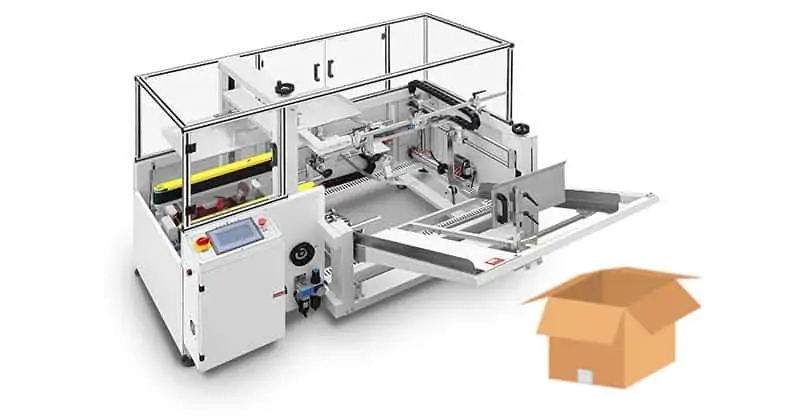
Case preparation is an important stage in many automated packaging lines. Before products can be placed into shipping cartons, flat case blanks need to be opened, shaped, and secured into a stable form. Automating this process can make carton preparation more consistent and reduce repetitive manual handling.
A Case Erecting Machine performs this process through a coordinated working cycle. Although machine designs can vary, the basic sequence generally involves carton feeding, opening, squaring, bottom flap folding, sealing or securing, and transferring the finished case to the next stage.
Step 1: Carton Blank Feeding
The cycle begins with a supply of flat carton blanks. These blanks are positioned in a magazine or similar storage area, where the machine can access them individually.
The feeding mechanism separates a carton from the stack and moves it into the forming area. Consistent carton dimensions and proper storage conditions can help prevent feeding problems.
Step 2: Opening the Carton
Once the blank is correctly positioned, the machine begins opening it from its flat configuration. Mechanical components engage with the carton panels and use the existing creases to create the basic box shape.
The quality of the carton has a significant influence on this stage. Damaged edges, poor scoring, or warped board can prevent the blank from opening smoothly.
Step 3: Squaring the Case
After the carton opens, it needs to be squared. This means positioning the panels and corners so the case reaches its intended shape and dimensions.
Proper squaring is important because an uneven case can cause difficulties during filling, sealing, conveying, or palletizing. Machine guides and forming components help maintain the required geometry during this part of the cycle.
Step 4: Folding the Bottom Flaps
Once the case is squared, its bottom flaps are folded into position. The sequence may vary depending on the carton design and equipment configuration.
Accurate flap movement ensures that the bottom of the case is prepared correctly before it carries products. Incorrect folding can result in an unstable carton or interfere with the following packaging stage.
Step 5: Securing the Bottom
The folded bottom may be secured using adhesive tape, hot-melt glue, or another suitable method, depending on the carton construction and machine design.
The purpose is to create a stable base that can support the contents during filling and subsequent movement through the packaging line.
Step 6: Transferring the Formed Case
After the bottom has been secured, the completed case is transferred toward the next stage. This may involve a conveyor, filling machine, case packer, or another packaging system.
The timing of this transfer is important in automated lines. The case erector must provide cartons at a rate that matches the requirements of connected equipment.
How Sensors Support the Cycle
Sensors help the machine determine whether specific steps have occurred. Depending on the equipment, sensors may detect carton presence, component positions, or other operating conditions.
These signals allow the control system to coordinate different mechanisms. If an expected condition is not detected, the machine may stop or generate an alarm to prevent further processing.
The Role of the Control System
The control system manages the sequence of operations throughout the cycle. It coordinates motors, pneumatic components, sensors, and other mechanisms so that each action occurs at the appropriate time.
Modern systems may also provide operators with information about machine status, faults, and operating parameters through an interface. This can make monitoring and troubleshooting more straightforward.
Factors That Can Affect the Working Cycle
The cycle may not perform consistently if the machine or cartons are not properly maintained. Common factors include:
- Variations in carton dimensions
- Poor-quality or damaged carton blanks
- Incorrect machine adjustments
- Worn mechanical components
- Sensor contamination
- Insufficient or inconsistent air pressure
- Excessive production speed
Identifying these factors can help operators determine why a machine is experiencing repeated forming or feeding issues.
Importance of Correct Machine Setup
Different carton sizes and constructions may require different settings. Guides, sensors, forming mechanisms, and other components should be adjusted according to the applicable carton specifications.
When changing formats, operators should follow the recommended setup procedure and test several cases before returning to normal production. This helps confirm that the new configuration is producing stable results.
Maintenance During Repeated Cycles
A case erector may perform the same sequence thousands of times during a production period. Repeated mechanical movement can gradually cause wear, making preventive maintenance essential.
Regular cleaning, inspection, lubrication where specified, sensor checks, and replacement of worn parts can help maintain predictable operation. Maintenance schedules should be based on the equipment manufacturer’s recommendations and actual operating conditions.
Connecting the Cycle to the Packaging Line
The case-erecting cycle is usually only one part of a larger workflow. The finished case may immediately enter a filling, packing, sealing, labeling, or palletizing process.
For efficient production, these stages need to work together. If downstream equipment is unavailable, the case erector may need to pause, while a shortage of formed cases can cause other equipment to wait.
The Role of Techflow Pack
Understanding the complete working cycle helps manufacturers evaluate case-forming equipment more effectively. Rather than focusing only on output speed, businesses can also consider carton compatibility, controls, changeover requirements, maintenance access, and integration with existing machinery.
This broader approach can help identify equipment that is suitable for the actual production environment.
A Repeatable Process From Flat Carton to Finished Case
The working cycle of a case erecting machine is a carefully coordinated sequence. Feeding, opening, squaring, flap folding, bottom securing, and transfer each contribute to producing a usable case.
When cartons are compatible, machine settings are correct, components are maintained, and the control system operates properly, the cycle can provide a consistent supply of cases for the next stage of packaging.