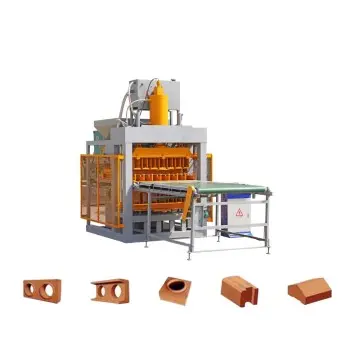
Demand for paving products can come from residential developments, commercial properties, landscaping projects, parking areas, and public infrastructure. Manufacturers serving these markets need to balance production volume with consistent dimensions, surface appearance, and product performance. As order quantities increase, automating more of the production process may help create a more coordinated manufacturing operation.
An Automatic Paver Block Making Machine is designed to automate selected stages of paving-block production. Depending on the model, these stages may include material feeding, mold filling, compaction, forming, and product transfer. The degree of automation differs between machines, so buyers should examine the actual functions included rather than relying only on the equipment’s name.
Understanding Automated Paver Production
Paver production begins with preparing the concrete mixture. Cement, aggregates, water, and any required pigments or additives are measured and mixed according to the intended product specification.
The material is delivered to the machine, where a controlled production cycle fills the mold and forms the paving unit. Vibration and compaction help distribute the mixture and create the required shape. Some systems also coordinate the movement of pallets or freshly formed products.
The formed units are then transferred to an appropriate curing area. Automation may improve coordination at the forming stage, but the complete operation still requires material control, inspection, curing, and storage.
1. Supporting Higher Production Requirements
Automated production can reduce delays associated with manually coordinating repetitive machine movements. This may help manufacturers maintain a more regular output when the equipment is supplied consistently with prepared material.
The actual production rate depends on paver size, mold configuration, cycle time, number of units formed per cycle, and operating conditions. It is also affected by mixer capacity, pallet availability, product handling, and curing space.
Manufacturers should request output estimates for the exact paving design they intend to produce. A maximum figure for a different block size or operating arrangement may not be realistic for their factory.
2. More Repeatable Forming Cycles
Automatic controls can coordinate machine movements and help standardize the forming cycle. When material proportions, mold condition, and operating settings remain consistent, this may support repeatable product dimensions.
Uniformity is important because paving units must fit together during installation. Differences in size or shape can create uneven joints and complicate laying work.
Regular inspection remains necessary. Operators should check sample pavers throughout production and investigate changes in dimensions, surface texture, color, or edge condition.
3. Producing Different Paver Designs
Many paver manufacturers serve customers with different design preferences. Products may vary in shape, thickness, surface pattern, color, and intended application.
A machine’s mold system determines which designs it can produce. Before investing, confirm the available mold range, replacement costs, and the procedure for changing configurations.
If the factory plans to produce colored pavers, ask whether the machine supports a separate face-mix arrangement or other required production features. These capabilities should be verified for the specific model.
4. Improving Factory Workflow
Automation can help organize the movement of materials and products, but an efficient factory requires a suitable layout. Mixing, feeding, forming, pallet handling, curing, and finished-product storage should be arranged in a logical sequence.
If material delivery is inconsistent, the machine may wait between cycles. If pallet movement is too slow, fresh pavers may accumulate and disrupt production. If curing space is inadequate, the factory may struggle to manage the output.
Production managers should measure performance across the entire line. This helps identify bottlenecks and avoid investing in additional machine capacity when another stage is limiting output.
5. Managing Color and Surface Quality
Paving blocks are often selected for their appearance as well as their functional performance. Color variation can become noticeable across a large paved area, so manufacturers need consistent pigment measurement and mixing procedures.
Molds should be kept clean and maintained to preserve the intended surface pattern. Material grading and moisture content should also remain controlled to support consistent compaction.
The factory should establish clear product samples or agreed appearance standards before manufacturing large orders. This helps align production with customer expectations.
6. Maintenance and Operator Training
Automatic machines require trained operators who understand the controls, production sequence, safety devices, and basic fault indicators. Maintenance should follow the manufacturer’s schedule and cover electrical systems, motors, hydraulic components where fitted, vibration assemblies, sensors, and moving parts.
Cleaning is particularly important in concrete production. Hardened residue can affect mold operation and finished-product quality.
Before ordering, confirm the availability of technical assistance, spare parts, installation support, and training.
Choosing Automation That Fits the Business
An automatic paver machine may be a worthwhile investment for manufacturers with steady paving-product demand and sufficient factory infrastructure. Its value depends on more than cycle speed: product quality, material supply, handling, curing, and maintenance all affect saleable output.
By checking machine capabilities against actual market requirements, manufacturers can select an automation level that improves production without creating unnecessary cost or complexity.